Core-shell particles consist of two parts: the core, which is a non-porous silica, and the shell, which is a porous silica gel layer chemically bonded to the core.
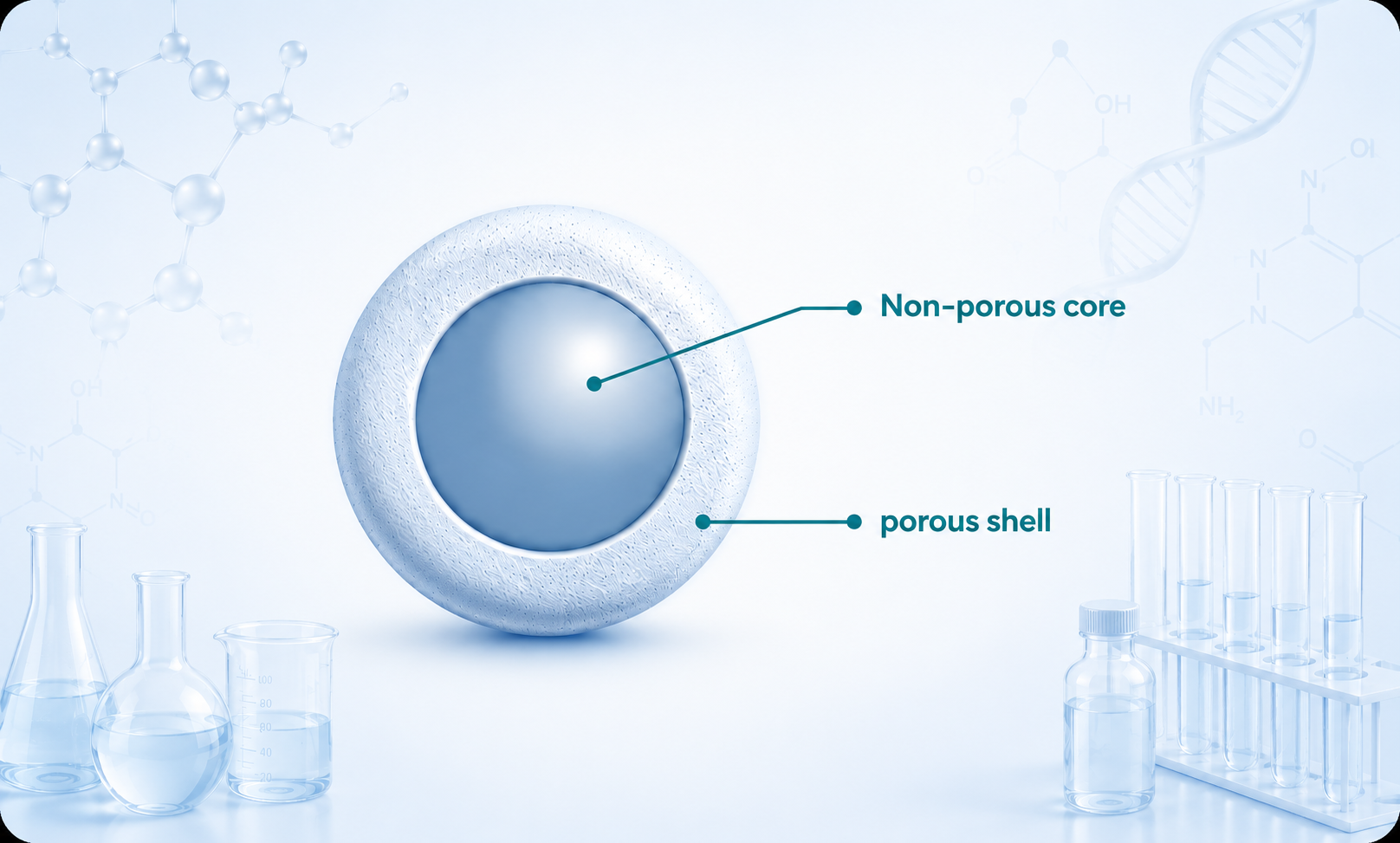
1 Structure of core-shell particle
The non-porous core enables the production of relatively uniform particles. Studies have shown that the particle size distribution is less than conventional fully porous particles. Furthermore, multiple uniform shell layers are added to create the porous layer, resulting in highly uniform particle sizes. As a result, core-shell particles exhibit a narrower particle size distribution compared to fully porous particles, delivering superior performance and reliable data.
Differences between core-shell and fully porous particles
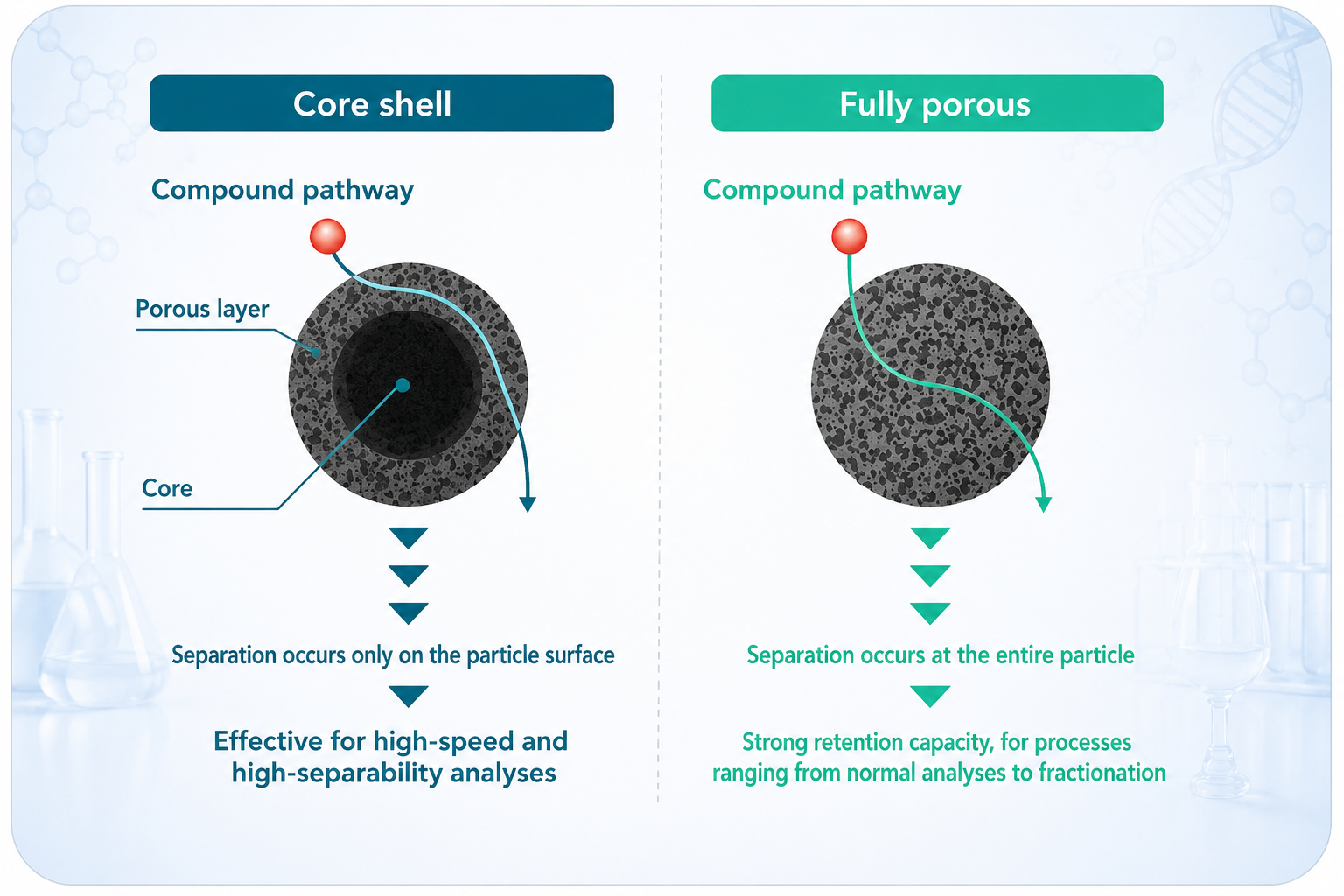
The left side of Fig. 2 illustrates the movement of solutes within a core-shell silica particles. In this case, solutes diffuse exclusively through the porous shell, where they interact with functional groups. This streamlined diffusion pathway results in a faster mass transfer for solutes within the particle. Conversely, the right side of Fig. 2 depicts the movement of solutes within fully porous particles. Here, solutes penetrate deeper into the particle, reaching areas closer to the center (as shown in the schematic diagram). This more complex and extended pathway increases diffusion time, leading to broader peaks during analysis.
Features of core-shell column
TAs discussed earlier, core-shell particles deliver the following chromatographic advantages due to their reduced mass transfer diffusion compared to fully porous particles:
Improved Peak Shape
Core-shell particles minimize solute diffusion within the column, enabling sharper and more defined peaks during analysis.
Reduced Column Backpressure
The porous structure of core-shell particles allows for a smaller pore volume through which the mobile phase flows, resulting in lower resistance and consequently reduced column backpressure.
Ideal for High-Speed Analysis
Ideal for High-Speed Analysis